

A well-written IEP is essential for a team of educators to support a student with unique learning needs. Yet many districts struggle with not only writing great IEPs but also maintaining comprehensive IEP notes, data, observations, and more. Standardizing IEP documentation is critical for special education teams to consistently and effectively provide services to students. With standardized IEP documentation, teams can dynamically adapt a student’s IEP as they grow.
This article unpacks the importance of standardizing IEP documentation practices and shares three simple steps for any district to get started, without overwhelming their teams. Let’s dive in.

Why standardizing IEP documentation matters
Solid IEP documentation is valuable beyond the legal requirements surrounding it. Clear IEP data helps teams write or revise stronger IEPs for students. Consistent IEP observations and notes align collaboration across the IEP team.
But standardizing IEP documentation becomes challenging thanks to:
- Incomplete or inconsistent service tracking: Teachers may use different tools, like notebooks or spreadsheets, to track services. They may also log service minutes and other IEP data at different intervals or in inconsistent formats.
- Inaccurate IEP data tracked: In some cases, providers may track incorrect or irrelevant data against a student’s IEP goal. In others, teachers might log outdated data based on an older version of an IEP.
- Silos of information: Often, administrators, special education teachers, general education teachers, and service providers are operating with different IEP information. Disparate data and documentation scattered across a team make it difficult to coordinate everyone’s efforts to consistently and effectively support a student with their IEP goals.
In the end, special education teachers and providers bear the burden of determining what to document, how to track it, where to save it, and when to share it. The patchy IEP information generated by an inconsistent process makes it difficult to see how services impact a student’s goals. The resulting mismatch of services and service minutes against IEP goals doesn’t just impact a student’s progress; it raises the risk of noncompliance with mandated special education laws.
This is why a systematic approach to all aspects of an IEP matters. Standardizing IEP documentation brings clarity, consistency, and efficacy to special education teams. Consistent IEP data demonstrate students’ progress towards their goals. Data-driven IEP meetings become more effective when the entire team uses the same terminology and language when discussing services, accommodations, and modifications. A centralized place for all IEP documentation to securely flow into and out of reduces the extra time educators spend searching for specific data or information.
How to standardize IEP documentation processes
Creating a systematic IEP documentation process isn’t just about writing or updating the IEP itself, though that is certainly part of the equation. Standardizing IEP documentation involves:
- Creating consistent IEP data formats and tracking protocols, such as how, where, and when to log service minutes and progress monitoring outcomes.
- Building shared terminology and language about services, accommodations, modifications, IEP goals, and more.
- Establishing IEP documentation processes for notes, observations, and more that the entire IEP team can commit to following.
It is also important to understand that standardization does not mean:
- Homogenized student supports, services, or goals: These components are what make IEPs powerful and should always be individualized to each child.
- Copy-pasted information: Here again, IEP data (notes, observations, progress monitoring outcomes, service minutes) should reflect the individual journey of each student, even if they receive support within a group setting.
- Restricted educator expertise: Each member of the IEP team knows what they are doing and offers critical knowledge to support student progress. Standardized IEP documentation should enhance, not hinder, everyone’s participation and collaboration.
With that in mind, let’s dive into three easy steps that your district can use today to begin standardizing your IEP documentation, no matter what state it may be in.
1. Start Small
Pick one detail within your existing IEP documentation processes to standardize. For example, your team may identify one specific service and focus on using the same terminology everywhere they talk about it. That means everyone references it as “small-group oral reading” across notes, observations, service minutes tracking, and even IEPs themselves. This change yields more consistent and accurate IEP data for students receiving this service.
Another example is standardizing when providers should log service minutes. That might mean having everyone complete those logs after each session or at the end of each day. The exact solution itself is less important than committing to one that fits everyone’s needs and capacity.
Give your team time to adapt until the change becomes second-nature. Then you can move on to standardize another element within your IEP documentation. With consistency and time, these incremental shifts pay off in big ways with clearer data and more effective discussions about IEPs.
2. Train, Support, Check In, Repeat
As with any change, upfront training boosts teachers’ confidence and increases the likelihood that the change becomes a regular habit. Provide support with each change you introduce, especially in the early days. Schedule regular time on your calendar to check in as a team, at least every semester or trimester. Hold space to reflect on how standardization shifts are going, what new challenges or opportunities may have arisen, and what successes the team has found.
3. Centralize, centralize, centralize
Scattered IEP documentation can make it challenging to effectively standardize practices around it, as well as see the effects of standardization on your IEP system as a whole. In parallel with small changes to your IEP practices themselves, centralize essential IEP documentation into a single location accessible (appropriately) to the IEP team.
Digital IEP tracking platforms are your greatest ally in this effort, as they offer templates and configuration workflows for standardizing your processes. Further, these platforms also allow you to define who sees what regarding a student’s IEP documentation, from the general education teacher, to the special education teacher, to the director of special education.
Example IEP Services Report from Brolly Platform
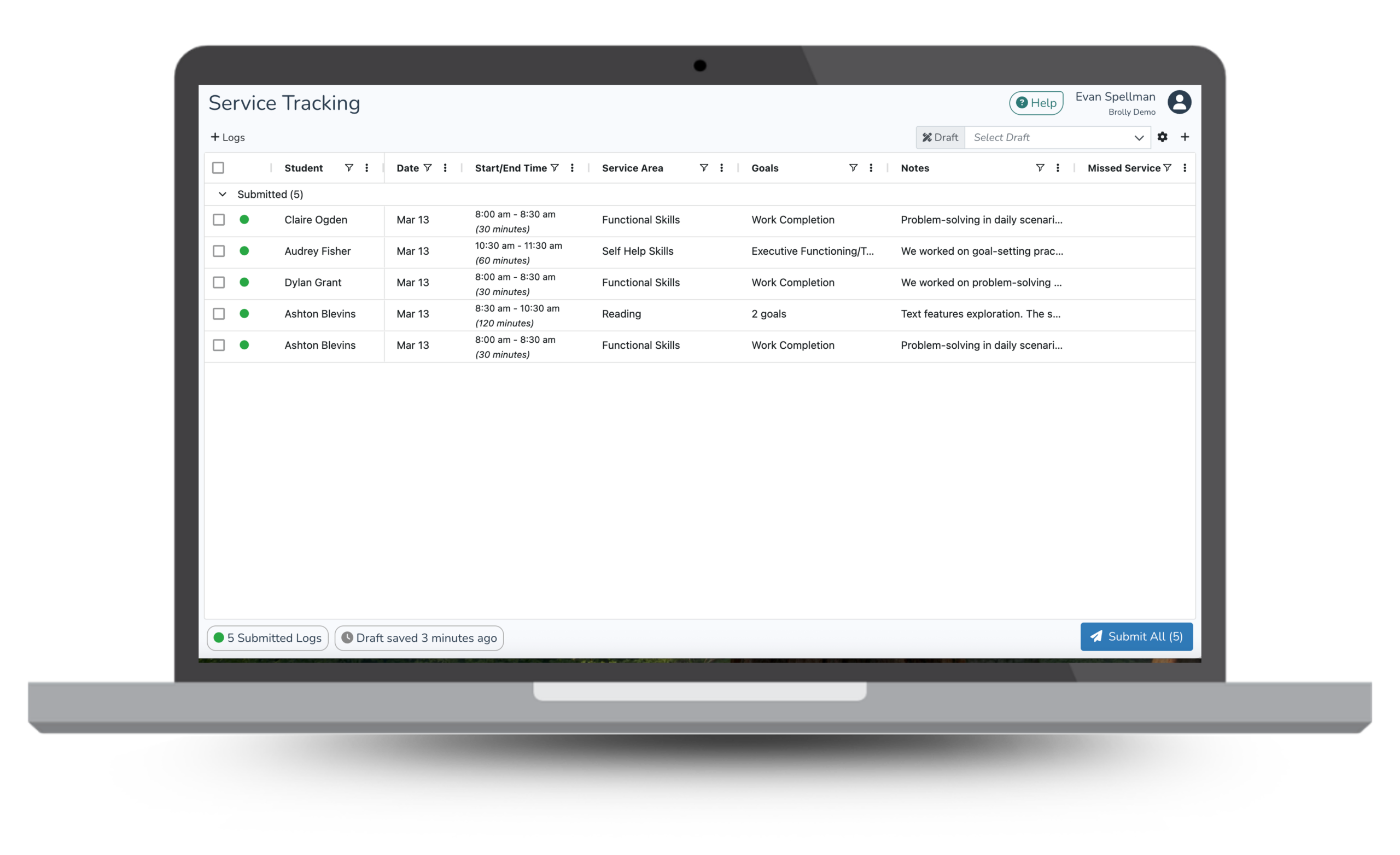
By bringing all IEP information and activity under one roof, you can easily see how well your team is adapting to new standardized practices. Soon, you will witness how these day-to-day efforts compound into more effective and consistent IEP delivery, leading to the most critical outcome of all standardization efforts: improved student progress toward their IEP goals.
Ready to standardize your IEP documentation and catalyze special education services? Download our worksheet to assess your practices and identify opportunities to start with today.
