

Nearly every special educator has encountered that IEP goal—the one written ages ago, vaguely, with no way to measure success against it accurately. But even with a beautifully written IEP goal, many educators struggle to effectively track a student’s growth against it.
The result? A stagnant IEP that slowly becomes less connected to the student it is intended to serve.
This article will explain not only how to measure IEP goals, but what elements must be in place to consistently and accurately measure these goals through a dynamic IEP strategy, one that grows alongside its student.
Table of Contents
Why Measuring IEP Goals Matters
Pursuing a goal without measuring your progress is akin to blindly throwing ingredients into a cookpot and expecting a very specific soup to come out. To make this delicious meal, you need to prepare your ingredients, set the stove to the right temperature, and monitor the pot as the ingredients alchemize.
Intentional measurement and progress monitoring also apply to IEP goals. Academic and behavioral data give educators insight into both where a student currently stands and how well they are moving toward their growth goal. It may also reveal misalignment between a student’s performance and the IEP goals themselves, allowing the IEP process to become more dynamic than static.
Further, data used to track IEP goal progress becomes concrete evidence of a school team’s compliance with state and federal law. Hard numbers and consistent qualitative data offer better protection than guessing how a student is doing or relying on provider or teacher anecdotes.
Yet districts face challenges with effectively gathering and analyzing data to measure IEP goals, including:
- Disjointed documentation: IEPs live on one platform. Services, service minutes, observations, and other data live elsewhere. Key information is spread far and wide, making it difficult to review holistically.
- Inconsistent progress monitoring: Providers or teachers do not regularly or correctly track progress monitoring, yielding data of varying quality and limiting the ability to track student progress.
- Scattered data collection strategies: Particularly with qualitative data, providers and teachers may use different formats, log data at different times, or use different strategies to capture details like observations.
These challenges create more than an administrative headache; they leave open gaps that risk expanding into a compliance issue down the road. Worse, they create a fractured learning environment for that student.
How To Measure IEP Goals and Objectives
Learning how to measure IEP goals and objectives well reduces compliance risk while establishing a more effective way to monitor student services and their effectiveness.
In short, to measure an IEP goal, educators need to:
- Identify the right services and tracking strategies
- Select an appropriate progress monitoring method
- Use the right tools to document both against the goal
Connect Service Tracking and Goal Progress
Tracking services against goal progress is crucial. When services become static and disconnected from student progress, the IEP itself, including its goals and documented services, can become less responsive overall to the student it is intended to serve.
Imagine a student has received the same 30 minutes of weekly reading intervention for three consecutive years but continues to fall short of their reading comprehension goals. This is a clear sign that this service has become disconnected from its IEP goal.
Instead, using service tracking data, this school team might scrutinize the gap with questions like:
- Has the intervention been delivered with fidelity?
- Is the intensity or frequency appropriate?
- Should we consider a different instructional strategy? Which ones have we already tried?
- Are we considering the right progress monitoring data for this goal?
By tracking and reflecting on both service delivery and student progress over time, teams can better determine what to change, when to change it, and how to individualize student supports more effectively.
Select an Appropriate Progress Monitoring Method
Many special educators struggle to measure an IEP goal when the data or progress monitoring method behind it does not align, like trying to measure the distance between two locations in cups of water.
Appropriate progress monitoring data for IEP goals should be:
- Objective
- Repeatable
- Easy to document consistently
- Align with compliance expectations
Not all goals must be measured the same way, either, even if they tie to the same learning need. A student with dyslexia, for instance, may have multiple individual goals related to literacy skills, but each goal should have its own method for monitoring a student’s progress toward achieving .
Let’s dive into two examples of IEP goal measuring tools (curriculum-based measures and observational and behavioral tracking) and what types of goals they best support for progress monitoring.
Curriculum-Based Measures
Curriculum-based measures (CBM) help teachers determine how students are progressing in basic academic areas. Typically, CBMs:
- Are simple and quick to administer
- Are given frequently to students (as often as weekly)
- Assess one specific skill related to the content recently delivered from their curriculum
- Quickly generate trends over time for a particular student’s performance through visual graphs
This strategy is effective for measuring goals related to math, reading, writing, or spelling. CBMs can rapidly generate a wealth of data to guide a teacher or provider’s decisions about instruction, curriculum, services, and classroom supports like modifications or accommodations.
Should there be one more sentence at the end of this paragraph introducing the two useful measuring tools below?
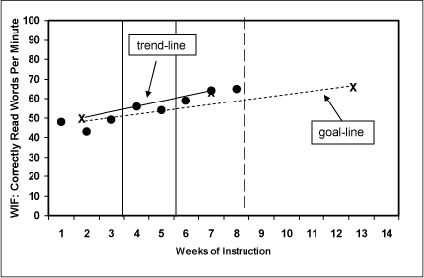
Example CBM for reading fluency for a student
Image source: Reading Rockets
Observation and Behavioral Tracking
Observational and behavioral data tracking offers contextual insights about a student’s academic progress alongside other progress monitoring data, such as benchmark assessments and CBMs. It is also used for tracking behavioral goals in an IEP.
Let’s revisit that example of a student with dyslexia. In their IEP, they not only have several literacy goals documented, but they also have a social-emotional goal tied to managing their frustration with reading through specific calm-down strategies. Teachers and providers can document their observational and behavioral data for this student in a number of ways, including:
- Counting the frequency with which a target behavior occurs in a given timeframe
- Tracking the duration of a behavior, such as how long it takes this student to complete a frustrating reading task
- Noting the location and time when a target behavior occurs
Use Customized Tools to Simplify Progress Monitoring Documentation
Selecting the right progress monitoring documentation tool is essential to streamline what is often a disjointed, cumbersome process for IEPs. The goal is to tie these data back to each IEP goal in one digital, centralized location.
When considering progress monitoring software, administrators should look for the following capabilities.
Real-Time Dashboards
A student’s learning journey is constantly evolving. Real-time dashboards in IEP software like Brolly by Level Data allow IEP teams to dynamically serve this student while staying in alignment about that student’s current performance. Through its nightly sync with a district’s IEP system, any changes to IEPs or services will seamlessly appear in the platform, equipping providers to keep services on track. The Student Report sheds light on the latest services, student supports, observations, progress monitoring data, and more for a student, painting a fuller picture of their growth and progress. Equipped with this knowledge, teams can focus not only not on “what happened” but also “what happens next”.
Streamlined Documentation
Platforms should simplify the IEP documentation process without reducing the quality of that documentation. Brolly, for example, centralizes services, service minutes, session notes, classroom supports, progress monitoring data, IEP meeting notes, and more with an intuitive data entry interface and templates. Most importantly, all this data ties back to each student’s IEP goals for easy tracking.
Stay Ahead of Gaps in Services or Progress
An administrator never wants to be caught off guard about gaps in a student’s services or their lack of progress toward IEP goals. As a progress monitoring solution, Brolly alleviates these concerns by surfacing gaps or undesired patterns through aggregated dashboards, configurable alerts, and service tracking, giving administrators lead time to address these issues and maintain IEP compliance.

A Key Ingredient of IEP Goal Monitoring: Establishing Measurable Goals
Measuring an IEP goal is only possible if the goal itself is measurable. With practice and support, educators can craft more effective IEP goals that articulate precisely what a student will achieve and how to measure that progress.
What Makes an IEP Goal Measurable?
The more specific, quantifiable, time-bound, and reasonable to a child’s learning needs an IEP is, the more measurable and useful it becomes. The Ohio Department of Education, Office for Exceptional Children offers six components of effective IEP goals, framed as reflective questions:
- For which student is this goal?
- What will this student do?
- To what level, extent, or degree?
- Under what conditions or circumstances?
- Within what length of time?
- How will progress be measured?
Examples of Strong vs. Weak IEP Goals
The table below/to the right shows just a few examples of real student IEP goals revised to improve their measurability.
Improving IEP Goals for Measurability
| A Weak Goal Is… | A Strong Goal Is… |
|---|---|
| Vague: Student will read random consonant-vowel-consonent words with ___% accuracy. |
Specific: Given a list of no more than ___ consonant-vowel-consonant words, student will repeat the word, identifying the beginning, middle and end sounds, with ___% accuracy in ___ of ___ trials. |
| Unmeasurable: Given daily assignments, student will improve reading skills by the end of the IEP date. |
Quantifiable: Given a grade level and [specific supports], student can read grade-level text orally with accuracy, appropriate rate, and expression on successive readings, with % accuracy at # WPM. |
| Open-Ended: Student will improve organizational skills by staying organized with ___% accuracy. |
Time-Bound: Given pictures of how to keep their backpack, locker, and desk organized, student will keep all three places organized, as measured by unannounced daily/weekly/monthly checks. |
| Unreasonable: The student will maintain three minutes of eye contact while interacting with an adult. |
Reasonable: The student will practice maintaining eye contact at least once while interacting with an adult. |
How To Write Measurable IEP Goals
Use the SMART Goal Framework
The SMART goal framework can help educators write or revise IEP goals. It asserts that every goal must be:
- Specific: The goal includes clear descriptions of the conditions, academic or functional skill, criteria for success, and timeframe in which the goal should be met.
- Measurable: The goal is quantifiable by a recognized and defined standard, ideally one that can be observed and compared with each evaluation.
- Achievable (or “action-phrased”): The goal includes observable actions rather than implied or vague ones.
- Relevant: The goal is both practical and ambitious for the student, based on relevant data (such as recent assessment results and previous growth trends) as well as the student’s unique circumstances and/or the team’s observations.
- Time-bound: The goal includes a specific timeframe in which a student is expected to achieve it.
As an example, through the SMART lens, the vague goal of “Student will improve reading fluency” can be rewritten as “Given a third-grade level reading passage, student will read aloud at a rate of 115 words correct per minute by the end of the semester.”
Choose the Right Baseline Data and Performance Criteria
Understanding where a student currently stands academically or behaviorally clarifies both what an appropriate goal might be as well as how ambitious it should be. For instance, if a third-grade student can successfully decode words, but very slowly, an IEP goal can focus specifically on fluency and, accordingly, include a measuring strategy specific to fluency (“Student will correctly read # of # words per minute during a four-minute fluency test.”)
Similarly, the baseline data used to craft this goal can also clarify the right criteria for measuring meaningful growth in fluency. If this student reads at a speed typical of a kindergartener (less than 50 words per minute), it would be unreasonable to expect them to read at a typical speed of a third grader (about 107–162 words per minute) in just a few months, even with intensive support in place. Instead, the goal should take into account a reasonable, but ambitious target for student growth, and importantly, change as the student receives services and makes progress.
Measuring IEP Goals Also Identifies When an IEP Goal Needs Revision
There are times when an IEP goal no longer fits the needs of its student. Perhaps the child has made significant progress and is ready for a more ambitious growth target. Maybe their learning circumstances have changed and momentum slowed, or a child may not be progressing against a brand-new IEP goal as quickly as expected.
A centralized IEP management system like Brolly enables educators to intervene proactively when a student is not progressing against their goals, no matter the reason. With clear data trends, ongoing service logs, and more, teams can review that student’s circumstances and make an informed decision.
Brolly Software Helps Your Team Create and Measure IEP Goals
Gone are the days when special educators scrambled to document and track the efficacy of IEP services against student goals. Brolly makes it easy to measure IEP goals through centralized progress monitoring data collection, interactive dashboards with chronological visibility into service session notes, early district-wide insights into IEP implementation patterns, and more. Brolly’s Goal Creator tool equips users to generate SMART, research-based effective IEP goals tailored to fit the needs of each student.
Take a tour today to see how Brolly can strengthen your data-driven IEP processes.
