

Today’s K–12 education funding landscape requires that district leaders make more strategic decisions about their resources than ever before. But challenges like staff turnover, renewed uncertainty about future federal funding, and even leaders’ perceptions of their own financial management skills can get in the way of smart fiscal choices.
During such turbulence, district leaders need to work closely and effectively with school principals, teachers, board members, parents, and the local community. Assessing your educational return on district investments (or eROI) can help you build stronger cohesion across this diverse group.
This article explores the value that eROI adds to these relationships. We will also share concrete ways to use this metric with key stakeholders that make you a more effective leader and move your organization toward its top priority: improving student learning.
1. eROI connects the dots across learning outcomes, usage, and spending
So many administrators build budgets, allocate resources, purchase programs, and more with incomplete information, and for a good reason. It’s hard to wrangle data measuring a program’s impact on learning, its usage, and its costs. But that precise intersection reveals when, where, and how student learning happens in the context of an educational investment.
Think about your district’s academic services designed to help struggling students, such as Tier II and Tier III interventions in an MTSS model. How do you know that you are getting the biggest academic “bang” for your “bucks” invested?
Student participation or usage data tells you if and where classrooms actually use a district-purchased resource, but usage alone isn’t a measure of learning. Academic outcomes like report card grades or progress monitoring scores show how students are growing, though not necessarily how a specific resource contributes to that growth. That resource’s cost reveals its impact on a district’s bottom line, but not on advancing its strategic priorities.
eROI approaches this data holistically, requiring administrators to ask deeper questions such as:
- Do we have redundancies among our Tier II programs? Are there programs we no longer need? Do teachers not know about certain district-purchased programs?
- Are teachers following vendor or district-provided guidance for a program with fidelity? If not, why?
- Do some non-district purchased programs have high utilization? If so, why?
- What academic impact does a higher dosage or frequency of usage of these Tier II resources yield? For which students, classrooms, and/or grade levels?
Instead of relying on piecemeal data or guesswork, you detangle patterns of each resource’s usage and cost against the relevant academic outcomes. And this line of investigation allows you to make more nimble decisions in context. That is the power of eROI.
2. eROI creates a shared, adaptable vocabulary
Another way eROI supports partnership is by establishing a shared vocabulary for talking about your district’s strategic priorities, investments, and outcomes. Though each stakeholder will have their own focus or goals, eROI offers a common way to tie their priorities back to yours and to everyone’s ultimate goal of supporting student learning.
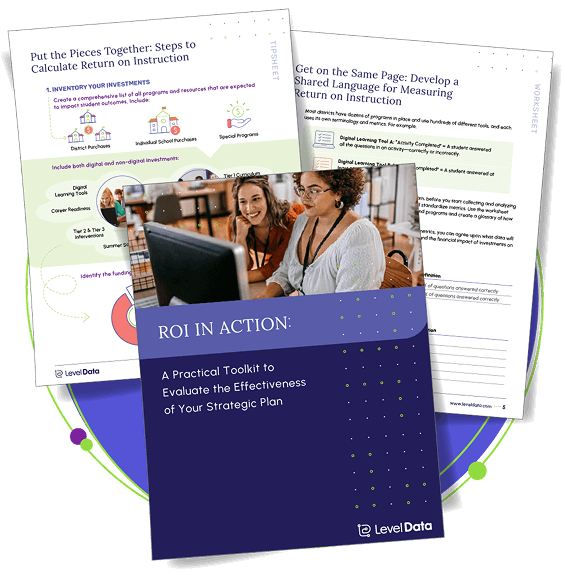
No matter your audience, you’ll want to ensure everyone understands the meaning of select terms you will likely use when discussing eROI. We’ve included example definitions to help you get started:
- Utilization/usage: Number of students using a tool or participating in an instructional program
- Fidelity of usage: Consistent, meaningful student engagement based on vendor recommendations (or district/school-defined goals)
- Return on investment: Calculation of usage as compared to the costs of a program or tool
- Return on instruction: Calculation of fidelity of usage, cost, and academic outcomes of a program or tool (as measured by report card grades, screening and progress monitoring, and/or state assessment scores)
Ultimately, these terms and the data behind them should contextualize why your team made specific investment or programmatic decisions, and for that, everyone needs to speak the same language.
3. eROI provides clarity and consistency during turbulence
As Dwight Eisenhower once said, “Plans are useless, but planning is indispensable.” When turbulence hits your district in the form of unexpected funding changes, staff turnover (even the good kind), or program shifts, your team must adapt in response—even if it means your original plans no longer apply.
Consistency amidst change is crucial not only to maintain student learning momentum but also to mitigate the aftermath of change. This is particularly important when district leaders depart, leaving not only a gap in managing their core responsibilities but also in institutional knowledge and strategic thinking.
eROI can guide you and your stakeholders through the fog of change. Though the inputs of this calculation might change, the measure itself remains constant, examining costs, usage, and achievement together against your district’s unique strategic focuses.
How to Use eROI Analyses with Every Stakeholder
Put these strategies into immediate practice with everyone from your fellow administrators to the school board.
District Administrators
Use eROI to get everyone, from a procurement manager to the Chief Academic Officer, on the same page about what “impact” metrics matter most for your district priorities and the key resources or programs purchased to drive them.
Partner with your fellow administrators to map every item in your budget against the strategic plan and its goals. Use this exercise to identify gaps or mismatches between financial and instructional priorities.
School Principals
Anchor principals on the connections between available resources, their impact, and your district’s strategic priorities.
Example: If eROI analyses reveal learning gains under specific conditions, you can guide school leaders to maximize this opportunity. Consider offering training to a building struggling to use a particular program consistently, or observing a school achieving academic success with a specific tool to identify recommendations for other school leaders.
School Board Members
Back up your recommendations for budgets, program changes, and more with valid, easily understood data sourced from eROI analyses. Use case studies or narrow in on specific patterns in your eROI data to illustrate a particular point.
Example: If you seek to expand a supplemental online reading curriculum, craft a story that emphasizes the conditions in which student achievement improved with it, and how to replicate those conditions with other classrooms, grades, and schools (with a proposed budget).
Parents and Families of Students
Use easy-to-understand terms and try to humanize your eROI-informed decisions through storytelling. These stakeholders may not need hard metrics but they do want to see your team hold itself accountable for spending taxpayer dollars responsibly.
Weave parent and community feedback into your narrative around why and how your district made certain changes, as well as how they benefit students.
Classroom Teachers
When staffing changes happen, especially larger shifts like a departing superintendent or school principal, use eROI to align with your classroom teachers and revalidate your district’s priorities (or explain why and how they are shifting in response).
Leverage eROI as a neutral way to analyze teachers’ concerns, ideas, or feedback about particular programs and their impact on student learning, giving you insight into how best to respond.
Watch our on-demand webinar to learn how eROI supported Farmington Municipal Schools to align curricula, instruction, and assessment in collaboration with teachers.
All Staff
- Amidst funding uncertainty, avoid the temptation to use quick “fixes” to save money, even with high-cost resources like coaching. Instead, use eROI to understand the non-fiscal costs of eliminating these programs.
- With eROI analyses as your compass, collaborate with staff to devise a more creative solution that addresses financial pain while maintaining those initiatives driving student growth.
eROI: A Metric to Unite Around
Measuring the academic impact of every dollar spent offers district leaders a quantifiable way to use lean financial resources to have maximum impact on student outcomes. But it’s the people utilizing these resources who determine how successfully those investments cultivate learning. Whether you are meeting with principals to introduce a new curriculum, hosting a town hall with the local community, or presenting a budget proposal to the school board, eROI is your ally in aligning your community to a shared purpose and a coordinated effort to achieve it.
Learn why hundreds of education leaders use Level Data’s Return On Instruction platform (ROI) to connect key goals with student outcomes in real time, thanks to actionable, AI-powered insights, analytics, and more.
