

Even amid massive changes in K–12 education, from the federal level to state and district levels, one goal remains constant: districts strive to put their limited dollars towards programs that actually impact student achievement.
But for most, this is far easier said than done, especially when so few districts don’t measure, analyze, and understand the educational return on investment (eROI) of everything they do for student learning.
Here are three reasons why every district leader must prioritize integrating eROI into their data-informed decisions.
1. eROI surfaces hidden cost savings
In the face of shrinking funding streams, some districts might consider cutting big-ticket items like professional development programs or districtwide edtech tools to save money. But as two district technology leaders recently pointed out, reducing tool redundancy and unused licenses can be as powerful (and much simpler) for a district’s bottom line.
In fact, a 2019 Level Data study found that two-thirds of educational software licenses were never utilized during a single school year. Imagine how many dollars schools could regain by eliminating this excess.
With eROI, administrators gain a clear view not only of the licenses purchased against their actual use, but also the funding sources tied to each program. This simple yet effective calculation makes it easy to find savings opportunities hidden in plain sight, like centralizing tool subscriptions across sites or eliminating excess seats.
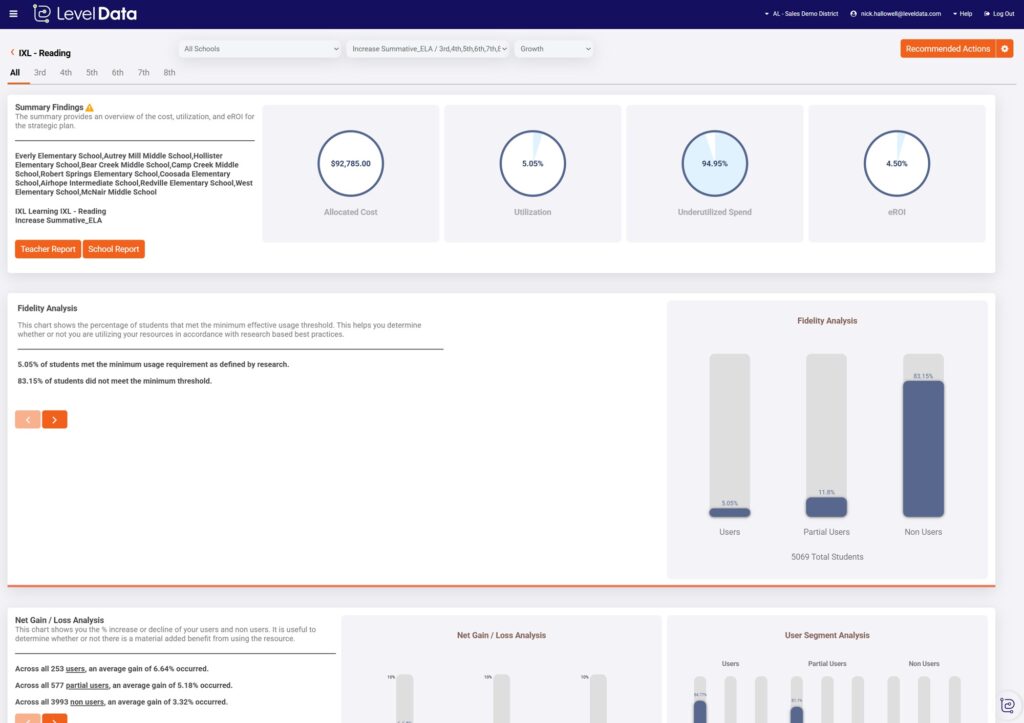
Even before examining the most essential factor—student achievement outcomes—district leaders can begin reallocating budget dollars.
2. eROI connects dollars spent with student gains achieved
But dropping unused licenses isn’t enough to calibrate a district’s investments to boost student achievement. As any veteran educator can attest, how a resource is used matters as much as whether it is used at all.
Yet this, too, is challenging for most districts. Why?
When rolling out a new program (say, an online reading curriculum), leaders primarily measure its impact from usage and cost data alone, struggling to link student achievement to that particular program among a sea of other initiatives. This narrow analysis risks throwing the proverbial learning gains out with the bathwater, especially if leaders only focus on cost savings by shrinking or eliminating programs.
Because what if that online reading curriculum does contribute to improved student performance when teachers utilize it as intended?
By correlating spending with both student learning gains and usage, district leaders can see precisely how every investment influences student achievement. This shift can radically change the way leaders approach funding decisions for students’ benefit.
Instead of cutting the curriculum as a line item in the budget, for instance, administrators might fund training or professional learning communities that boost teachers’ engagement with this curriculum. Over time, that upfront investment may ultimately save the district more money by reducing the number of students needing Tier 2 or 3 literacy interventions.
That is the power of eROI.
3. eROI empowers educators and vendors to prioritize impact
Outcomes-based contracts (OBCs) are gaining momentum in K–12 education. Designed to link payments with targeted learning gains, OBCs shift the focus of vendor-district partnerships from features and services to student growth. As one advocate shared via The74, “The question is no longer ‘What can this program do?’ but ‘What outcomes will my students achieve as a result?’”
eROI aligns well with OBCs and other efforts to connect district investments with student learning gains. But it may surprise educators to recognize that, while eROI helps districts hold vendors accountable for impact, it also benefits the vendors themselves.
Take the creator of that online reading curriculum. This vendor should offer guidelines to its partner districts about how often and for how long students should use the curriculum to reap the literacy benefits. Districts should then train and hold teachers accountable for following this usage expectation.
In theory.
The reality is, vendor guidelines aren’t always available or have not been proven effective. Even in cases with evidence backing program usage guidelines, districts don’t always follow those recommendations. Yet eROI still helps both parties remain accountable to student success.
eROI requires a clear usage and performance goal to generate the most accurate analysis, ensuring districts partner with vendors to establish these guidelines (or co-create them where they don’t exist). In kind, vendors are incentivized to help district partners understand and implement usage recommendations for their solutions—ones that truly correlate with the achievement gains promised.
eROI keeps everyone invested in helping students grow.
Fund investments behind real student growth with Level Data
Level Data provides powerful, easy-to-use solutions that remove the complexity from K–12 data management. With our Return On Instruction (ROI) platform, district administrators gain confidence, clarity, and critical insights into the eROI of every investment, from tutoring to edtech tools to professional development. No more guesswork, no more gut checks.
See exactly where your dollars directly impact student learning for the better—schedule a demo today.
