

The most successful coaching programs often share characteristics like consistent feedback practices, right-sized coaching cycles, and essential coaching data, just to name a few. But keeping these components in harmony with one another is a feat for any district to accomplish.
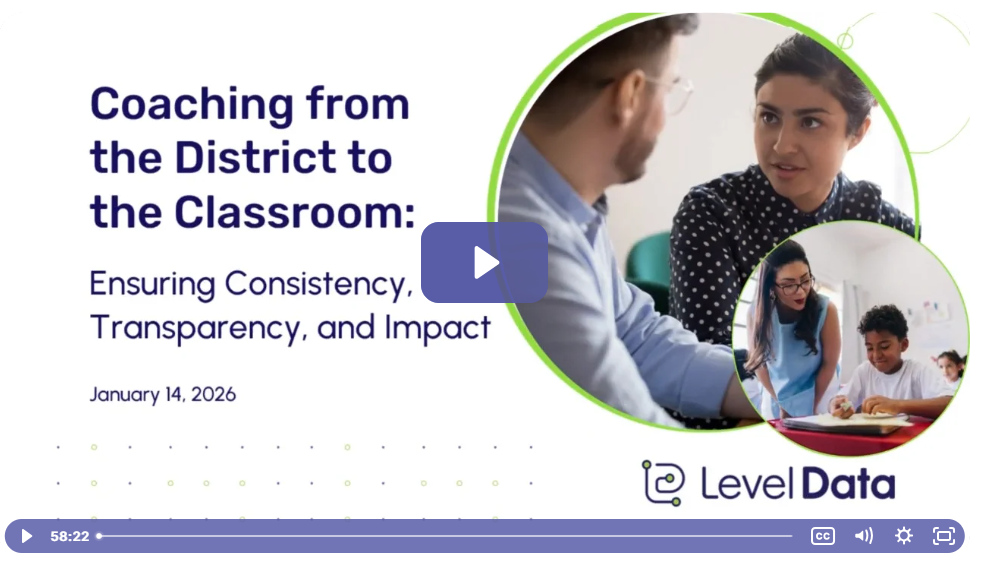
Level Data sat down with a Chief of Schools and a school principal from two Georgia districts to learn how they approached the monumental task of crafting coaching programs with transparency, consistency, and most importantly, impact. Though their programs may differ, both leaders named actionable strategies that any district administrator, school leader, or coach can embrace to maximize their returns on this major investment.
Keep reading to discover ways to ensure every educator receives high-quality, individualized support to cultivate student growth.
Establish trust: “Exhausting” every opportunity
Implementing a new program or process requires getting the right people on the same page and, ultimately, trusting that the changes they are asked to make will improve learning. And every education leader recognizes just how challenging it is to establish this trust.
That’s why Dr. Raymond Barnes, Chief of Schools at Savannah-Chatham County Public School System (SCCPSS), “exhausts the why” of coaching in every possible way.
At SCCPSS, Dr. Barnes launched a coaching framework that impacts over 30,000 students. But before a single coach met with any teacher, his team spent time upfront mapping and codifying precisely what coaching (and its data) would look like—from the Chief of Schools down to the classroom as well as across adjacent district departments.
The goal? Ensure that coaching flows and cadences remain in lockstep at every level.
SCCPSS implemented Grow by Level Data as the foundation for this structure. Grow centralizes documentation, tracks coaching activities, and measures impact over time. More importantly, it creates transparency at every level of an organization, essential to building trust, the desired coaching culture, and alignment with district goals.
“It is very important that everyone understands our vision of a streamlined, comprehensive coaching model,” said Dr. Barnes. “If we don’t define the culture, then the culture defines us … We use Grow to build capacity with our people.”
Dr. Bryan Willis-Reese, principal at Allgood Elementary School (AES) in DeKalb County Schools, also exhausts opportunities to nurture trust, particularly with technology. Implementing Grow has helped AES improve the efficiency and consistency of coaching practices across the building. Real-time observation notes, automated feedback delivery, shared dashboard tracking, and more “led to more time in coaching, less time on paperwork, and our teachers feeling more supported,” shared Dr. Reese.
Grow also expands the leadership team’s capacity to support coaching. No longer does the team spend hours gathering and analyzing data from disparate sources during weekly meetings. Instead, attendees arrive already prepared with key insights and patterns from their own data analysis, ready to focus on actionable solutions in service of teacher growth.
Dr. Reese emphasized that, with consistency in coaching feedback and expectations established, teachers became more receptive to coaches’ suggestions, further cultivating their trust.
Create cohesion: Intersecting feedback, observations, and strategic priorities
Coaching data is essential for ensuring a program’s fidelity. But it’s when data aligns with bigger, collective priorities that real momentum builds.
At AES, school walkthroughs are opportunities to strengthen the link between coaching and school-wide objectives. No matter which leader does it, each looks for evidence of teaching practices that tie back to specific school improvement goals. Grow helps leaders access recent feedback provided to each teacher, as recent as the previous day.
This timely information empowers Dr. Reese and his team to act on relevant coaching feedback anytime, anywhere. He reflected, “It helps our teachers see how our daily practices connect to our collective vision. Coaching feels cohesive, not random.”
It helps our teachers see how our daily practices connect to our collective vision. Coaching feels cohesive, not random.
That cohesion can be replicated all the way up to the district. Dr. Barnes explained, “I am very far away from the classroom. I have to lean through people in coaching cycles. I give feedback to network superintendents to build their capacity to then coach principal managers, who in turn coach school principals to give feedback to their coaches.”
But he emphasized that a unified coaching infrastructure like Grow is critical to ensuring feedback stays consistent and in alignment. “A teacher shouldn’t hear three different things to work on from four different people,” Dr. Barnes shared. “Grow allows everyone to see that one action step agreed upon [by teacher and coach], so they can rally behind that one action step for that employee.”
Build in increments: Expanding impact through small iterations
Achieving synchrony in a district-wide coaching program—let alone between individual coaching relationships—may feel like a gargantuan task. Dr. Barnes encouraged fellow administrators to remember the long-term impact of these efforts, and not just on student learning.
“We believe that the number one [teacher] retention strategy is the quality of feedback provided,” Dr. Barnes shared. “If teachers are getting better, they want to stay on your team because they are seeing progress.” In this spirit, he advocated that every teacher and leader receive feedback or coaching in some capacity, even in small ways.
Dr. Reese also reminded leaders that “perfect is the enemy of good,” and not to forget the value of recognizing the smallest successes, whether it’s a teacher using a new instructional strategy for the first time or celebrating school-wide gains in student achievement. “Recognizing our incremental growth reinforces a culture of continuous improvement.”
Dr. Barnes echoed these sentiments: “It’s OK to go slow in order to Grow!”
It’s OK to go slow in order to Grow!
Ready to grow your coaching program’s impact? Grow by Level Data gives you the digital infrastructure to strengthen coaching at every level, from the classroom to the central office. Request a demo to learn more.
