Skip to content

Take the Stress Out of State Reporting

A tiny mistake, like a wrong digit in an address or an accidental blank field, can turn into a big headache during reporting season. All too often, these little data entry errors end up costing valuable time, resources, and even funding.

With Level Data Validation, you can quickly check every field against federal, state, and district rules as you enter the data so you’ll know instantly if something needs attention. Your team will benefit from real-time, automated support built directly into your Student Information System (SIS) to ensure every student record is accurate, compliant, and complete.

Give Everyone the Tools to Get It Right the First Time

Validation supports every role across the district because we know keeping student data accurate and up to date is a team effort.

Frontline Staff

Catch errors in real time to make data entry easier, more accurate, and less frustrating.

Technology Directors

Reduce manual workload and maintain consistent, accurate data across all schools through automated validation.

Superintendents

Ensure compliance and maximize funding by identifying and resolving data issues before they affect reporting.

Districts report up to 70% fewer errors in their first state submission after implementing Validation.

Seamless Support Inside Your SIS

From the front office to the district reporting team, staff get real-time feedback that helps them fix errors as they go, not after the fact.

screenshot of bulk age/grade mismatch data
Identify Common Issues in Bulk

Cleaning your SIS with Validation is quick and simple. It thoroughly scans your entire system for patterns, inconsistencies, and hidden issues, then shows you exactly where fixes are needed.
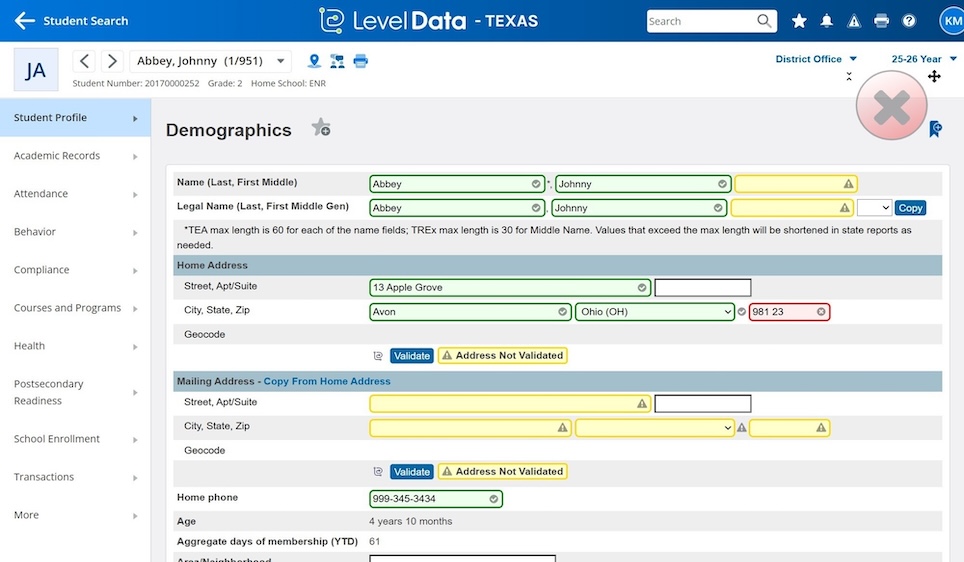
screenshot of student validation page with color highlights
Fix Errors Before State Submission Deadlines

Validation helps identify issues with demographics, enrollment, special education, and discipline data using federal, state, and district rules. It highlights errors as you enter information, guiding you with clear visual indicators for quick corrections.
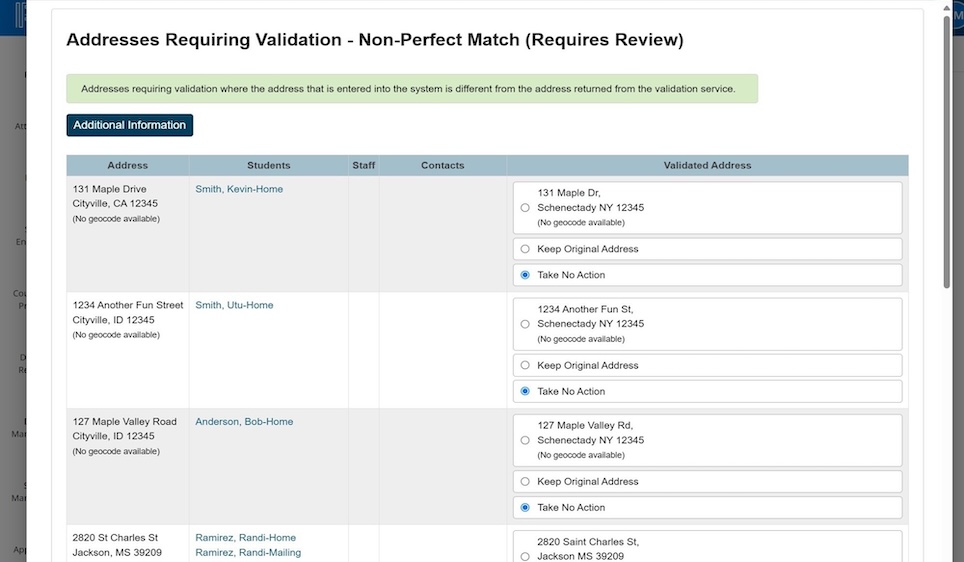
screenshot of address validation screen
Protect Funding with Accurate Student Addresses

Validation makes it easy to check for address formatting issues, missing apartment numbers, and vacant properties. By cross-referencing USPS records with other reliable datasets, we ensure that every address is clean, complete, and standardized.

Take a Self-Guided Tour of Validation
for PowerSchool or Skyward

Start Tour

See What Technology Administrators Are Saying

Union County Schools

Level Data’s State Validation service is one of the most useful tools we have added to our Technology Toolbox. The screens are easy to use, easy to understand and most importantly, valuable time savers.
Timothy Barnado

Executive Director of Technology
Union County Schools

After installation of the Level Data State Validation Suite, we were able to clear a few hundred errors within half an hour. Because the interface was so simple and intuitive, there was no training required. It really was as simple as opening the tool and clicking ‘Fix’.

Jodi Perdue

SIS and Data Coordinator
Rabun County Schools
Grapevine Colleyville School District logo

Validation reports streamlined food service operations, connecting families efficiently. As a result, the district gained an extra $50,000 in funding—an achievement that truly paid for itself.
Michael Jagoditsh

Director of Data Systems
Grapevine-Colleyville ISD
Rhea County School District logo

I used to write custom SQL reports that could take anywhere from 5-10 minutes to a couple of days to create. Now, the results are all presented on one page, making it easier for users to access and address the errors.

Tim Jones

System Software Specialist
Rhea County District Schools

Validation Resources

3 Reasons Why Districts Should Prioritize Accurate Data This Year

Bad data makes for bad decisions. More specifically, poor-quality data means leaders act without the right information and may inadvertently lead their communities down the wrong path. Today’s environment for educators makes this challenge even harder. As the Department of Education continues to cut back on its workforce and initiatives, and the current administration radically changes K–12 education funding parameters, districts must equip themselves with essential tools to navigate these turbulent storms. Chief among them: accurate data.    Data integrity concerns are particularly painful in K–12 education. From over-reported numbers of school shootings to dubious trends in school desegregation orders to concerns about grade inflation and reliability, districts may face incorrect numbers in many areas. These issues can cause issues with funding, student services, and much more, all of which ultimately affect students’ success in the classroom.  In this article, we break down three key reasons why accurate data should be every district’s top priority in the 2025-2026 school year. #1: Maximize funding Top of mind for nearly every district leader in the country is the future of their funding sources. But even in a world where education funding remains the same, inaccurate data still poses risks to a district’s monetary resources in two ways. Misallocated funds First, inaccurate data may result in a district failing to receive federal or state dollars that should be allocated to its schools. Take one example from the not-so-distant past. In 2018, California implemented a new statewide data system for students who fall under specific classifications. Its purpose was to simplify how the state calculates funding allocations for thousands of school districts. However, upon its rollout, leaders discovered over 10,000 data and calculation errors, including “wrong enrollment numbers, duplicate student information, and missing information about accommodations for students with disabilities.” As a result, many districts faced the possibility of losing funds they actually qualified for (and certainly needed) to support their students.  This is just one of many situations in which data errors can short-change districts, literally. No matter which funding model a district uses, accurate data is essential to ensure it receives maximum monetary resources from all its funding sources.  Underutilized funds Second, even with correctly allocated funding in place, data quality issues can lead to those dollars being underutilized across schools. And no district administrator wants to discover that their organization is not maximizing its fiscal resources. This challenge goes beyond unfilled seats for an after-school service or unused student licenses for learning software (though addressing these kinds of gaps is important). Accurate data is also critical for districts to understand which of their many investments tangibly and quantifiably drive student success, and which ones are a waste of already limited dollars.  There are many kinds of data available for educators to assess which programs, digital tools, trainings, and other investments are driving student achievement. But actually, triangulating that impact in quantifiable ways is particularly challenging for districts.  In the corporate world, this “return on investment” (ROI) is simple to calculate as a profit-to-cost ratio. In contrast, “educational ROI” (eROI) is more complex to calculate. With every investment, districts weigh not only their bottom line but also student outcomes in the classroom, student and staff wellbeing, and many other goals often found in their strategic plans.  However, once eROI is well understood for a particular investment, a district leader can make a more sound decision—based on real data, not “gut checks” or educated guesses—about where to spend their dollars most impactfully.  But first, this potential requires clean, accurate data.   Level Data’s Return On Instruction solution simplifies eROI calculations by streamlining data gathering across all instructional tools and programs, then providing a clear analysis correlating investments with positive academic outcomes. Watch our webinar to discover how the power of accurate data transformed Lee County Schools’ strategic plan into measurable outcomes. #2: Minimize time and effort An educator’s most precious resource is time. Unfortunately, even today, many districts sink hours (and dollars) into manual efforts to resolve data accuracy or cleanliness issues. These efforts include: Manually correcting incorrect data entered into the student information system; Revising reports to ensure aggregate student data accurately reflects trends across buildings (especially ones that fail to interconnect smoothly); Flagging inaccurate staff classification data to remain compliant with labor laws (more on this in a moment); Resolving data workflow issues between two systems that pose a security risk as well as a data accuracy concern; And the list goes on. When districts must navigate outdated software systems, varying technical knowledge across staff, and slim budgets, the risk of inaccurate data increases, as does the amount of human time and effort required to address it.   To ensure data integrity, districts must invest in the right tools and processes that minimize human errors, time, and effort. This means looking for solutions that identify data errors as early as possible in the data workflow, ideally at the point of entry, as Level Data’s Real Time Validation solution does. By addressing issues at their source, districts can trust that their systems are trustworthy, with clean records of information, without further overloading their staff’s plates. Discover how the Real Time Validation solution empowered two districts to take back time and energy from their data management processes. #3: Increase confidence in compliance Last, but in no way least, data errors increase a district’s risk of falling out of compliance with state and federal laws. The cost of even minor violations quickly adds up for a single district in penalties and additional work to resolve these issues under scrutiny.  Let’s look at one place where inaccurate data and compliance risk collide: Individual Education Plans (IEPs). IEPs are central for serving students protected under the Individuals with Disabilities Education Act (IDEA). This law requires that services provided be reasonably calculated to help students meet their goals. To fulfill this mandate, districts must keep records of services provided to these students, hold regular reviews like IEP meetings to evaluate the impact of their services, and ideally,…

Read More

Overcoming Data Management Challenges in K-12 Education: Insights from Peninsula and Rhea County School Districts

Managing data for K-12 school districts presents a unique set of challenges. Districts handle vast amounts of information, ranging from student attendance and academic performance to staff records and financial data. Ensuring the accuracy and security of this data is extremely important, yet the process is often complicated by outdated systems, limited budgets, and varying levels of technological proficiency among staff. Additionally, compliance with state and federal regulations adds another layer of complexity, requiring attention to detail and constant updates to data management practices. Balancing these demands while striving to improve educational outcomes makes data management a critical, yet daunting, task for school districts. Level Data's Validation tool has been a game-changer for school districts like Peninsula School District, in Washington State and Rhea County School District in Tennessee, both who have been using Validation for more than five years. In a recent conversation, Carol Winget, Student Database Administrator from Peninsula School District, and Tim Jones, System Software Specialist from Rhea County, reflected on their experiences and the impact the tool has had on their data management processes. Key Insights Data Challenges Carol shared her transformative experience with Validation. "Before using Validation, we had to manually filter through data column by column to identify issues. This was a very time-consuming process, often taking hours. With Validation, I can now access the necessary information in just a few minutes, allowing me to stay on top of data issues more frequently and reduce the overall number of errors by more than 70%." Tim echoed Carol's sentiments, explaining Validation has streamlined their data validation process. "I used to write custom SQL reports that could take anywhere from  5-10 minutes to a couple of days to create. Now, the results are all presented on one page, making it easier for users to access and address the errors." Features that Make a Difference Both Carol and Tim have found Validation to be transformative in their data management processes. The tool's features, such as color-coding to indicate missing data and the "green dot" feature to indicate whether a student record has enough data to be successfully loaded, have been particularly helpful. Additionally, the automatic update feature of the Validation plugin ensures that both teams always have the latest and greatest validation checks without having to manually update the plugin. Tim mentioned, "The simplicity of the plugin allows my users to handle the validation tasks, freeing me up to focus on more complex problems." Easy-To-Use Tool For Everyone Along with its simple implementation, Carol and Tim discussed the benefits of Validation for other departments and staff within the school district. As Carol explained, "The student services, special education, and other departments have all benefited from using the tool for state reporting purposes, as it helps clean up their data." To highlight the tool's impact on office turnover and data entry standards, Carol remarked, "The validation tool has made it easier to manage office turnover. I can easily direct new staff members to Validation to find and fix errors." Following Carol’s lead, Tim acknowledged the simplicity of Validation has been a key factor in its success. "The users have become very proficient in using the tool," Tim said. "They find it easy to use and it saves them time compared to running different SQL reports." Different Districts, Same Experience Although Carol and Tim’s districts are different in terms of geographical location, size and community they serve, their experience and satisfaction with Level Data’s Validation solution is the same. Both Carol and Tim expressed their enthusiasm for Validation. "We love it and can't imagine working without it," said Carol. A valuable asset for Tim at Rhea County, its ability to streamline the data management process and empower staff to maintain data accuracy with ease, made Tim jokingly state, "If I told my schools that the Level Data tool was going away, they would react with outrage," a testament to the tool's indispensable role in their daily operations. To listen to the full discussion and hear more about Validation from Carol and Tim, check out the    on-demand version here.

Read More

Ready to Take the Guesswork Out of Data Entry?

Join the more than 1,500 districts nationwide using Validation to simplify state reporting, improve compliance, and free up valuable time.

Book a Free Consultation
Back To Top